The field was never even
Why unsupported founders need networks, guidance, and support systems before good ideas can rise.
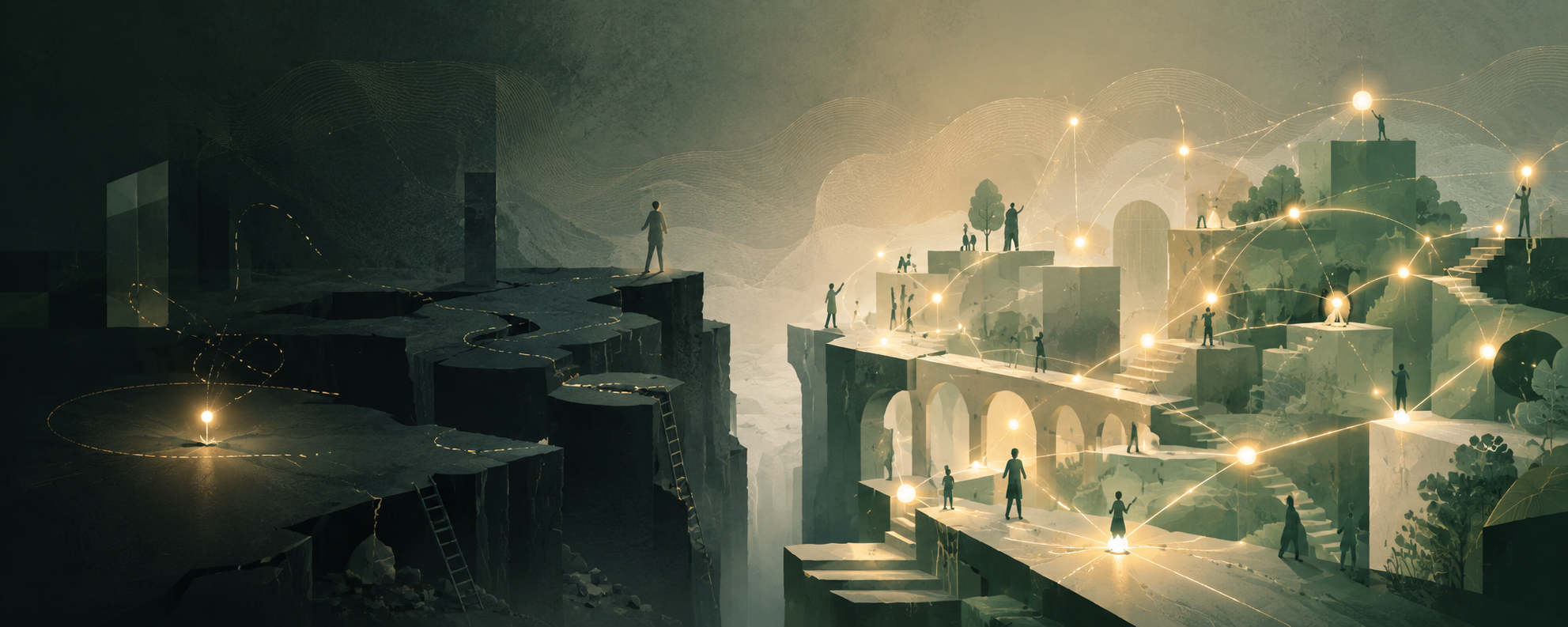
The field was never even because talent was never the whole game. Ideas survive when people have maps, networks, and someone close enough to say, "keep going."
One data point keeps rattling around in my head:
Children with parents in the top 1% of income are 10x more likely to become inventors than children with below-median income parents.
Not 10% more likely.
10x.
That is not a small gap. That is not a "try harder" gap. That is not a "just network" gap, unless your networking strategy includes being born into the right house, which feels like a fairly limited growth hack.
The usual story is that good ideas rise to the top.
I don't think that is true.
I think supported ideas rise to the top.
The 10x gap is not a motivation problem
The stat comes from the paper Who Becomes an Inventor in America? The Importance of Exposure to Innovation, by Alex Bell, Raj Chetty, Xavier Jaravel, Neviana Petkova, and John Van Reenen. The researchers linked deidentified patent records, tax records, and school records to study more than 1 million inventors in the United States.
Opportunity Insights summarizes the finding plainly: children with parents in the top 1% of the income distribution are ten times more likely to become inventors than children with below-median income parents.
The paper also finds that these gaps persist even among children with similar early math scores, which matters. It means the opportunity gap is not only about talent. It is about exposure, proximity, examples, encouragement, and access to the rooms where invention starts to feel possible.
The NBER digest puts the same point in human terms: children who grow up in innovative places, or around inventors through family connections, are more likely to become inventors themselves. That exposure changes not only whether people invent, but what kinds of things they later build.
That is the part that stays with me.
Because if exposure to innovation changes the odds of becoming an inventor, then founder support is not a nice-to-have. Startup networks are not decorative. Mentorship, examples, technical help, and early encouragement are not soft extras after the serious work is done.
Founder support is not a bonus after the serious work. It is part of the field.
Same talent, different room
The person with money, examples, connections, encouragement, technical help, legal help, design help, business advice, and someone nearby saying "yeah, keep going" is playing a different game than the person trying to build alone after work with 11 tabs open and no clue which advice is real.
Same talent. Different room. Different support. Different odds.
That is the part people like to skip because it makes the motivational posters less useful.
A lot of potential does not disappear because people are lazy, unserious, or not founder material. It disappears because they never get enough support to turn the fog into a path.
And that does not only apply to patentable inventions. It shows up in startups, small businesses, community projects, software tools, creative work, and every early idea that needs a little structure before it can survive contact with the real world.
A first-time founder without a startup network is often not missing ambition. They are missing translation.
They need help turning "I think this matters" into the next concrete step. They need to know what to ignore, what to test, what to write down, what to ask, what to build first, what to charge for, what to measure, and when the answer is simply "keep going, this part is supposed to feel messy."
The support stack people inherit
Some people inherit a support stack before they even know to name it.
- Parents who know how companies work
- Friends who can make investor introductions
- Someone who understands contracts
- A former manager who knows customer discovery
- A college roommate who can ship the first version
- A family that can absorb a failed month, a failed year, or a failed bet
- Someone nearby saying, "yeah, keep going"
None of that guarantees success.
But it changes the cost of trying.
It changes how quickly a person gets useful feedback. It changes whether they can recover from a bad first attempt. It changes whether they know that the weird, lonely, uncertain part of building is normal or whether they interpret that feeling as proof they do not belong.
That is why innovation inequality is so stubborn. The gap is not only money. It is information. It is language. It is confidence. It is knowing which questions are normal. It is being able to see people like you do the thing before you decide the thing is allowed to be yours.
Why evenfield exists
That is what evenfield is being built for.
Not to make building easy.
Building is not easy. Anyone selling that is probably wearing a microphone in a rented Lamborghini.
The point is to make building less dependent on whether you already have the map, the money, the network, and the quiet confidence that comes from seeing people like you do it before.
More people should be able to find founder support before they are already polished enough to impress a room. More unsupported founders should be able to get clear next steps, useful context, and a sense that they are not crazy for starting before they have everything figured out.
Because the field was never even.
But it can be made more even.
Not by pretending everyone starts in the same place.
By building support systems that meet people closer to where they actually are.
More people should get to find out what they are capable of before the system quietly sorts them out.
That is the bet.
Sources
Research referenced in this essay.